The Convergence Problem: SHEIN, Zara, and Platform Retail in Fast Fashion
SHEIN grew past $38 billion by inverting Zara's model entirely, network coordination instead of vertical integration. But its cost advantage rested partly on a tariff loophole that just closed. A framework-driven breakdown of both companies' strategic paths forward.

A Strategic Case Analysis
Abstract
SHEIN and Inditex (Zara's parent company) represent two structurally distinct answers to the same competitive question: how to compress the fashion cycle from design to shelf. Zara's answer, refined over four decades, is vertically integrated proximity manufacturing. SHEIN's answer, assembled in under a decade, is an algorithmically coordinated network of independent suppliers operating at a scale and speed no vertically integrated retailer can match. This analysis applies the resource based view, dynamic capabilities theory, Porter's value chain and Five Forces frameworks, Blue Ocean strategy, and institutional legitimacy theory to explain why SHEIN's growth has outpaced Zara's on volume while remaining structurally more fragile, and what each firm's next strategic move should look like given current regulatory and tariff pressure.
1. Two Value Chains, One Industry
Porter's value chain framework (Porter, 1985) is the natural starting point because Zara and SHEIN have built almost mirror image versions of it. Zara's model concentrates design, cutting, and finishing near its Arteixo headquarters in Spain, enabling what Ferdows, Lewis, and Machuca (2004) documented in Harvard Business Review as a rapid fire fulfillment system: small batch production, frequent store deliveries, and a deliberate practice of manufacturing below forecasted demand so that scarcity itself becomes a marketing device. The tradeoff is cost. Proximity sourcing and owned factories carry a structurally higher unit cost than offshore mass production, which Zara offsets through brand equity and physical retail presence rather than price competition.
SHEIN inverts nearly every element of this chain. Rather than owning production, it coordinates thousands of independent Guangzhou area manufacturers through a shared digital ordering and forecasting system, a structure closer to what supply chain scholars call a networked or virtual value chain than to Zara's integrated one. Where Zara commits to production runs based on trend forecasting by designers, SHEIN commits to small test batches (commonly cited in industry reporting as a few hundred units) and uses real time sales, click through, and social engagement data to decide which designs receive reorders within days. This is not simply "fast fashion, but faster." It is a different position on the make to order versus make to stock spectrum entirely, closer in logic to agile software development's build measure learn loop than to traditional apparel merchandising.
2. Dynamic Capabilities as the Actual Source of Advantage
The resource based view (Barney, 1991) would attribute competitive advantage to valuable, rare, and hard to imitate resources. On paper, neither firm's individual resources are unique. Cheap Asian manufacturing capacity is not proprietary, and neither is e-commerce infrastructure. What is harder to imitate is what Teece, Pisano, and Shuen (1997) call dynamic capabilities: the organizational routines that let a firm sense market signals, seize opportunities, and reconfigure resources faster than rivals. SHEIN's actual moat is not any single supplier relationship but the integrated sensing and reconfiguration loop between its app, its manufacturer network, and its pricing engine, a set of routines built over years that a competitor cannot simply purchase or replicate by copying the storefront.
This distinction matters for the strategic question of imitability. Zara's capability (rapid but centrally controlled small batch production) has proven difficult for competitors like H&M to replicate for two decades, because it required rebuilding an entire logistics and design organization around it. SHEIN's capability is different in kind: it is a coordination and data capability layered on top of manufacturing capacity that is not owned, which means the barrier to entry is organizational and technical rather than physical. This is also its greatest vulnerability, since the same lack of ownership that gives SHEIN flexibility also gives it less direct control over labor conditions, quality consistency, and compliance, precisely the categories in which the company has faced the most regulatory scrutiny.
3. The Financial Picture
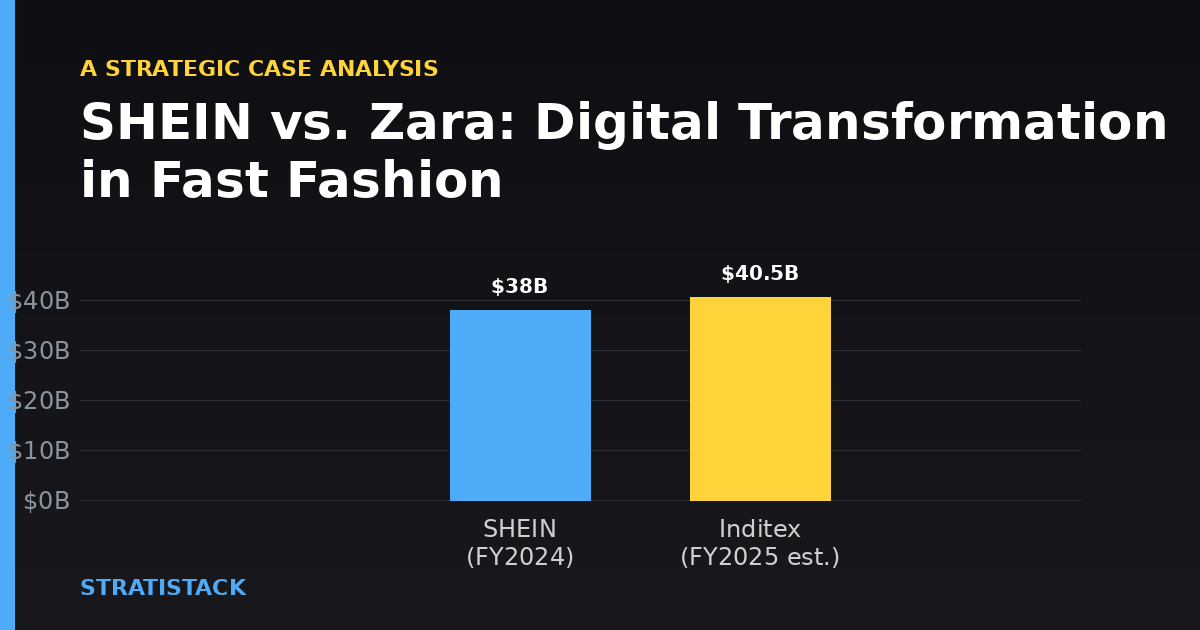
The scale gap between the two companies has narrowed considerably faster than most industry observers expected a decade ago. SHEIN's full year 2024 revenue rose 19 percent to approximately 38 billion dollars, even as net profit fell by close to 40 percent to roughly 1 billion dollars amid rising competition and logistics costs. Inditex, by comparison, reported net sales of 28.2 billion euros (about 30.4 billion dollars) for the first nine months of its 2025 fiscal year, an increase of 2.7 percent, with gross margin holding at a robust 59.7 percent and net profit up 3.9 percent to 4.6 billion euros. The pattern these figures reveal is instructive: SHEIN is winning on top line growth and volume, while Inditex is winning on margin quality and profit conversion, a divergence that maps closely onto the classic differentiation versus cost leadership distinction in Porter's generic strategies framework, except that SHEIN's cost leadership has come without the operating leverage typically associated with it.
SHEIN vs. Inditex: Revenue Growth Comparison
| Company | Period | Revenue | YoY Growth |
|---|---|---|---|
| SHEIN | Full Year 2023 | $32.2B | — |
| SHEIN | Full Year 2024 | $38.0B | +19% |
| Inditex | First 9 Months, FY2024 | $29.6B | — |
| Inditex | First 9 Months, FY2025 | $30.4B | +2.7% |
Note: SHEIN figures are full calendar year. Inditex figures reflect nine months of its fiscal year for direct year over year comparison; Inditex's full year run rate annualizes higher.
(Note: SHEIN figures are full calendar year; Inditex figures for the most recent period reflect nine months of its fiscal year, so the right hand bars understate Inditex's full year run rate, which annualizes closer to the low 40 billion dollar range.)
4. Institutional Legitimacy and the Regulatory Backlash
Suchman's (1995) theory of organizational legitimacy distinguishes between pragmatic legitimacy (stakeholders tolerate a firm because it serves their interests) and moral legitimacy (stakeholders believe the firm's conduct is appropriate). SHEIN has built enormous pragmatic legitimacy with price sensitive, trend driven consumers, but it is now absorbing a wave of moral legitimacy challenges that Zara, despite operating in the same industry, has largely avoided. In 2025, French regulators imposed a 150 million euro fine on SHEIN over unauthorized cookie data collection and a separate 40 million euro penalty for deceptive discounting and environmental claims, while Italy's competition authority followed with a 1 million euro fine specifically for greenwashing, finding that SHEIN's marketing around emissions reduction and recyclability contradicted its own documented emissions increases in 2023 and 2024. This is precisely the legitimacy gap that institutional theory predicts when a firm's operational model outruns its compliance and disclosure infrastructure: rapid scaling without matching investment in verifiable governance eventually converts into a stream of regulatory and reputational costs.
Compounding this, the United States ended duty free de minimis treatment for low value shipments from China and Hong Kong on May 2, 2025, exposing SHEIN's core cross border logistics model to tariffs that initially reached as high as 145 percent before settling near 30 percent or a flat per item fee. Following a further tightening in the exemption on August 29, 2025, Bloomberg transactional data showed SHEIN's US sales falling roughly 8 percent year over year in September, one of its weakest months in three years. This is a direct illustration of Porter's Five Forces in action: SHEIN's cost advantage rested partly on a regulatory loophole rather than a durable structural efficiency, and the moment government policy closed that loophole, a portion of its competitive advantage evaporated overnight, something that cannot happen to Zara's largely tariff insulated European manufacturing footprint.
5. Reframing the Recommendations Through Blue Ocean Strategy
Kim and Mauborgne's (2005) Blue Ocean framework argues that sustainable advantage comes not from competing harder within an existing value curve but from reconstructing the curve itself, simultaneously reducing certain cost drivers while raising others that competitors have neglected. Applied here, SHEIN's credible path forward is not to compete with Zara on brand prestige (a battle it cannot win given Zara's four decades of accumulated brand equity) nor to compete purely on price against emerging ultra low cost rivals like Temu (a race to the bottom with no durable winner). Instead, the Blue Ocean move is to raise the previously neglected factor of verifiable sustainability and compliance infrastructure, which SHEIN's own regulatory record shows is currently a source of cost and risk rather than differentiation, while continuing to reduce the traditional fast fashion cost drivers of retail overhead and inventory risk that it has already mastered.
Concretely, this means treating supply chain auditability, recycled material sourcing, and third party certification not as public relations expenses to be minimized but as the next competitive frontier, since the regulatory environment across the European Union and increasingly the United States is moving toward mandatory disclosure regardless of whether SHEIN adopts it voluntarily. A firm that builds genuine verifiable infrastructure ahead of regulation converts a compliance cost into a competitive moat against smaller, less capitalized ultra fast fashion entrants who cannot afford the same investment. This is a direct application of what strategy scholars call a first mover regulatory strategy: shaping the eventual rules of the game rather than merely reacting to them.
For Zara, the strategic imperative implied by these same frameworks runs in the opposite direction. Inditex's dynamic capability is the tightly coupled physical and digital retail network it has spent decades building, and its greatest risk is not SHEIN's price competition (a battle Zara has never tried to win) but complacency in digital personalization and speed, the exact terrain where SHEIN's data driven merchandising has genuinely outpaced traditional retailers. Inditex's own recent results, with online and store sales both contributing to growth and continued investment in logistics expansion, suggest the group already recognizes this and is extending its integrated model into digital channels rather than attempting to copy SHEIN's disaggregated one, a sound application of resource based logic: build on the capability you already have a genuine advantage in, rather than attempting to out execute a rival on their own terrain.
6. Strategic Lessons for Practitioners
- A cost advantage built partly on regulatory arbitrage is not a durable cost advantage. SHEIN's de minimis dependent pricing model was exposed as a policy contingent advantage the moment US trade rules changed, a risk vertically integrated, geographically proximate competitors like Zara do not carry to the same degree.
- Speed and scale do not automatically confer legitimacy. Institutional theory predicts precisely the pattern SHEIN is now experiencing: operational capability that outruns governance and disclosure infrastructure eventually generates a legitimacy deficit that regulators price in as fines.
- Differentiation and cost leadership are not permanently exclusive, but pursuing both simultaneously without matching infrastructure investment produces exactly the margin compression visible in SHEIN's 2024 results: revenue up sharply, profit down sharply.
- The next competitive frontier in fast fashion is not price or speed, both of which are increasingly commoditized, but verifiable sustainability and supply chain transparency, an underpriced factor that Blue Ocean logic suggests is ripe for a firm willing to invest ahead of mandatory regulation.
- Incumbents should extend their genuine capability rather than imitate a challenger's structurally different model. Zara's advantage lies in integrated control, not raw speed, and competing on SHEIN's terms would mean abandoning the very capability that makes Zara defensible.
7. Conclusion
SHEIN and Zara are not simply two competitors pursuing the same strategy at different speeds. They represent two coherent but structurally opposed answers to the fast fashion value chain problem: integration versus network coordination, brand equity versus algorithmic personalization, and physical scarcity versus digital abundance. SHEIN's growth trajectory demonstrates the power of its model but also its exposure, since a structure built on cost arbitrage and light touch governance is acutely sensitive to the very regulatory and trade forces now converging on it. Zara's more modest but steadier growth reflects the durability of vertically integrated brand equity, though it carries its own risk of digital complacency if it fails to keep extending its capability into personalization and speed. For SHEIN, converting explosive growth into durable leadership requires treating sustainability and compliance as a genuine strategic investment rather than a defensive public relations expense. For Zara, protecting its position requires continuing to digitize its already differentiated capability rather than attempting to fight SHEIN on cost.
References
- Barney, J. (1991). Firm resources and sustained competitive advantage. Journal of Management, 17(1), 99 to 120.
- Barnes, L., & Lea Greenwood, G. (2006). Fast fashioning the supply chain: shaping the research agenda. Journal of Fashion Marketing and Management, 10(3), 259 to 271.
- Ferdows, K., Lewis, M. A., & Machuca, J. A. D. (2004). Rapid fire fulfillment. Harvard Business Review, 82(11), 104 to 110.
- Kim, W. C., & Mauborgne, R. (2005). Blue Ocean Strategy. Harvard Business School Press.
- Porter, M. E. (1985). Competitive Advantage: Creating and Sustaining Superior Performance. Free Press.
- Suchman, M. C. (1995). Managing legitimacy: Strategic and institutional approaches. Academy of Management Review, 20(3), 571 to 610.
- Teece, D. J., Pisano, G., & Shuen, A. (1997). Dynamic capabilities and strategic management. Strategic Management Journal, 18(7), 509 to 533.
- Autorité de la concurrence and Italian Competition Authority (AGCM) enforcement decisions against Shein, 2025.
- Inditex Interim Nine Months 2025 Results, published December 2025.
- Reuters and Bloomberg reporting on US de minimis tariff policy changes and Shein pricing, 2025.