The Impossible Promise: MoviePass and the Economics of Subscription Disruption
MoviePass promised unlimited movie theater visits for $9.95 a month and grew faster than Netflix; then burned through hundreds of millions of dollars in under two years. Here's what platform theory and Porter's Five Forces reveal about the collapse, and why the 2022 relaunch works.

A Strategic Post-Mortem
Abstract
MoviePass remains one of the most instructive failures in modern subscription commerce; not because its thesis was foolish, but because it was directionally correct and economically unfinanced. This analysis reframes the MoviePass saga through five management frameworks: multi-sided platform theory, flat-rate/adverse-selection economics, Christensen's disruptive innovation model, Porter's Five Forces, and the "blitzscale-first" growth doctrine that shaped Silicon Valley strategy in the 2010s. Read together, they explain not just that MoviePass failed, but why the same failure mode recurs whenever a company tries to subsidize behavior change faster than its balance sheet can absorb it.
1. The Business Model, Restated in Platform Terms
MoviePass's pitch was simple: a flat monthly fee, later cut to $9.95, for access to one theatrical movie per day. What is less often stated precisely is that MoviePass was not a retailer; it was attempting to build a multi-sided platform sitting between subscribers, exhibitors, and studios. Harvard Business School's own case materials frame it exactly this way: CEO Mitch Lowe was building a platform designed to extract value from increased theater traffic through several mechanisms simultaneously, while struggling to convince stakeholders the model could work. That framing matters because multi-sided platform theory (Rochet & Tirole, 2003) makes a specific prediction: a platform's viability depends on its ability to monetize at least one side sufficiently to subsidize the other. MoviePass never solved this. It heavily subsidized subscribers and never built the offsetting revenue stream; data licensing, advertising, or box-office equity that the model required.
2. Framework One: Flat-Rate Pricing and the Economics of Adverse Selection
MoviePass is frequently and imprecisely compared to Netflix. Netflix's flat-rate economics work because its marginal cost per additional stream is near zero. MoviePass's marginal cost per additional visit was a full-price movie ticket, paid to the exhibitor at close to retail. This is not a streaming-economics problem; it is closer to an insurance-economics problem, and it maps directly onto Akerlof's (1970) adverse selection framework: a flat price attracts disproportionately the heaviest users, and if the insurer (MoviePass) cannot price-discriminate against them, losses compound with volume rather than being smoothed by it.
The academic literature on "flat-rate bias" (Lambrecht & Skiera, 2006) documents the more common version of this problem: consumers systematically overestimate usage and overpay on flat plans, which is profitable for the seller. MoviePass inverted this bias in the seller's disfavor; heavy users self-selected into the plan and consumed far above the level the $9.95 price point could sustain, turning the model's core value proposition into its principal liability. The filed disclosures bear this out starkly: MoviePass's parent company, Helios and Matheson, reported an average monthly cash deficit of approximately $25 million from September 2017 through May 2018, a figure that grew to roughly $40 million in May 2018 alone as subscriber growth accelerated. Growth, in this model, was not a solution to the deficit; it was its primary driver.
3. Framework Two: Disruptive Innovation Theory, Misapplied
Commentators reflexively described MoviePass as "disruptive," but Christensen's (1997) model of disruptive innovation specifically describes entrants that first serve overlooked or overserved segments with a lower-cost, structurally different value proposition, then move upmarket as incumbents fail to respond. MoviePass did not have a structurally lower cost base than the incumbents it was disrupting; it had a higher cost base per unit of consumption than the price it charged. That is not disruption; it is subsidized market-share buying, a distinct and much riskier strategic pattern sometimes labeled "growth-at-all-costs" or, more critically, "blitzscaling" (Hoffman & Yeh, 2018). Notably, one widely circulated case study on the company is literally titled "MoviePass: The Get Big Fast Strategy", which is the more accurate diagnostic label than "disruption."
4. Framework Three: Porter's Five Forces and Supplier Power
Porter's Five Forces framework highlights a structural constraint MoviePass never escaped: the bargaining power of its suppliers, the theater chains, remained almost entirely intact. MoviePass had no leverage to negotiate wholesale ticket pricing at scale because exhibitors correctly perceived the service as a threat to their own pricing power rather than a demand-generation partner. The proof is in the counter-response: once MoviePass's collapse became apparent, AMC and Regal did not partner with it; they launched their own competing subscription products (AMC Stubs A-List, Regal Unlimited), which captured the same demand at sustainable, internally-priced economics. The theaters, in Five Forces terms, simply absorbed the innovation MoviePass had proven the market wanted, without absorbing MoviePass's cost structure.
5. The Empirical Trajectory
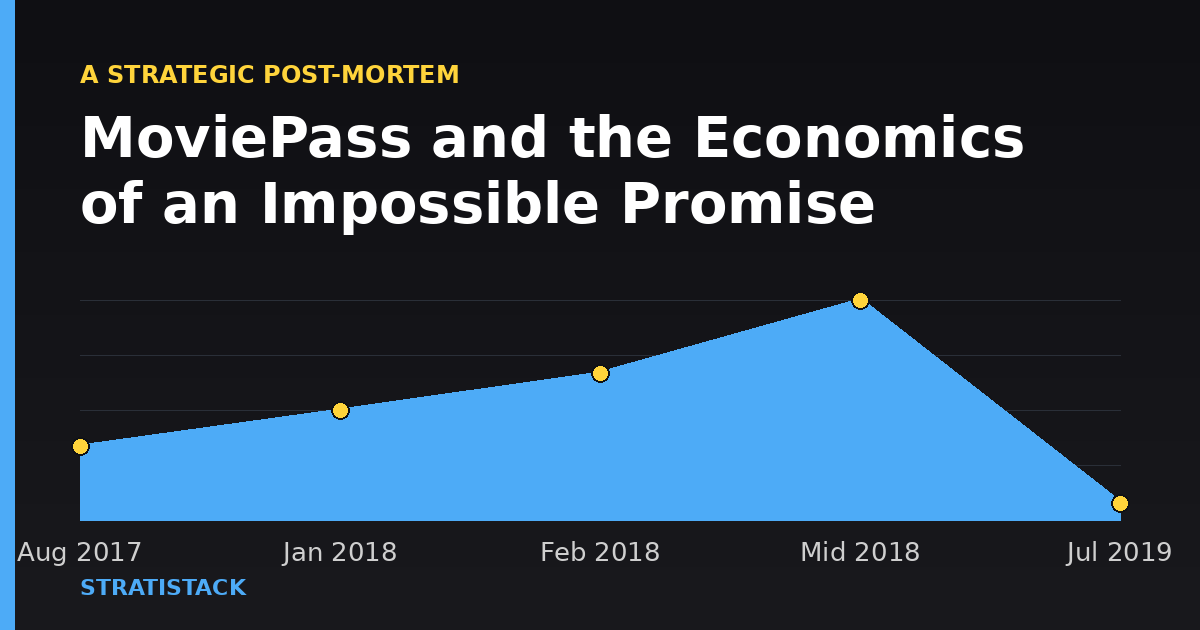
The subscriber curve tells the underlying story more efficiently than narrative can:
MoviePass Paying Subscribers, Aug 2017 – Jul 2019
| Date | Paying Subscribers |
|---|---|
| Aug 2017 | 1,000,000 |
| Jan 2018 | 1,500,000 |
| Feb 2018 | 2,000,000 |
| Mid 2018 | 3,000,000 |
| Jul 2019 | 225,000 |
6. The Behavioral and Governance Failure
The response to the cash crisis compounded rather than solved the underlying problem. Management alternated between price hikes, blackout dates on popular titles, and usage caps (from unlimited, to three films per month), each move signaling desperation rather than strategic recalibration and each triggering the exact cancellation wave that flat-rate economics predicts when a subsidized product's core value proposition is withdrawn. Subsequent regulatory scrutiny surfaced a governance failure layered atop the economic one: the Federal Trade Commission later found that MoviePass had used so-called "trip wires" to invalidate the passwords of subscribers who used the service heavily, blocking as many as 75,000 paying customers from access, while also storing subscriber data in plain text. This transforms the case from a pure unit-economics failure into a cautionary example of what happens when a company facing a cash-burn crisis manages the symptom (heavy usage) through covert restriction rather than transparent repricing.
7. The Second Act: What Correction Looks Like
The company's 2022 relaunch under co-founder Stacy Spikes, who reacquired the brand and customer list out of bankruptcy for a sum reported at under $250,000, is the clearest natural experiment available on what a corrected model looks like. Rather than unlimited access at a flat national price, the relaunched MoviePass uses tiered, city-based monthly credit allotments, directly targeting the adverse-selection and cost-mismatch failures of the original design. As of 2026, the relaunched company continues to operate as a private entity offering tiered credits alongside an ancillary prediction-market product (Mogul), and has reported profitability since 2023 — a structural reversal from the unprofitable growth phase that ended in the original entity's bankruptcy. This is the strongest available evidence that the underlying consumer demand MoviePass identified was real; what was broken was the pricing architecture, not the market insight.
8. Strategic Lessons for Practitioners
- A subscription model is a bet on the variance of usage, not the average. Flat pricing only works when the seller can absorb, price for, or contractually cap the tail of heavy users; MoviePass priced only for the mean.
- Platform businesses need at least one fully monetized side before scaling the subsidized side. MoviePass scaled subscribers aggressively while the advertising, data, and studio-partnership revenue streams remained aspirational.
- Disruption requires a genuine cost advantage, not just a lower price. A lower price funded by cash burn is a marketing strategy, not a business model, and it is only as durable as the balance sheet behind it.
- Supplier power that is not contractually neutralized will be used against you the moment you succeed. Exhibitors' launch of competing in-house subscription products after observing MoviePass's demand validation is the textbook Five Forces response.
- Restrictive pivots executed without transparency compound reputational damage. The FTC's later findings show that covert usage-limiting mechanisms did more brand damage than an honest price increase likely would have.
9. Conclusion
MoviePass is best understood not as a story of a bad idea, but of a correctly identified consumer want financed by an unsustainable capital structure and an incomplete platform strategy. Its 2022–2026 relaunch under original founder Stacy Spikes, now profitable on a fundamentally different pricing architecture, is the clearest evidence that the thesis was sound even where the first execution was not. For strategy practitioners, the case is less a cautionary tale about subscription commerce broadly and more a precise illustration of what happens when growth-stage capital allocation outruns unit economics discipline in a business with real, non-digital marginal costs.
References
- Akerlof, G. A. (1970). The market for "lemons": Quality uncertainty and the market mechanism. Quarterly Journal of Economics, 84(3), 488–500.
- Christensen, C. M. (1997). The Innovator's Dilemma. Harvard Business School Press.
- Dueck, L., & Jiang, G. F. (2019). MoviePass: A Netflix for Moviegoers? Ivey Publishing / Harvard Business Publishing, Product W19657.
- Hoffman, R., & Yeh, C. (2018). Blitzscaling. Currency.
- Lambrecht, A., & Skiera, B. (2006). Paying too much and being happy about it: Existence, causes, and consequences of tariff-choice biases. Journal of Marketing Research, 43(2), 212–223.
- Porter, M. E. (1979). How competitive forces shape strategy. Harvard Business Review.
- Rochet, J.-C., & Tirole, J. (2003). Platform competition in two-sided markets. Journal of the European Economic Association, 1(4), 990–1029.
- Yoon, E., & Joachimsthaler, E. (2018, May 18). How to fix MoviePass. Harvard Business Review.
- U.S. Securities and Exchange Commission filings, Helios and Matheson Analytics Inc., Forms 424B5, S-3, 10-Q, 8-K (2018).
- HBO Documentary Films. (2024). MoviePass, MovieCrash [Documentary film]. Max.