Barber Cardiosystems Case Analysis: Cost Leadership and the No-Layoff Commitment
A full Barber Cardiosystems case analysis: why its bonuses and no-layoff policy power its cost leadership strategy, and how to respond to a 10% competitor price cut.

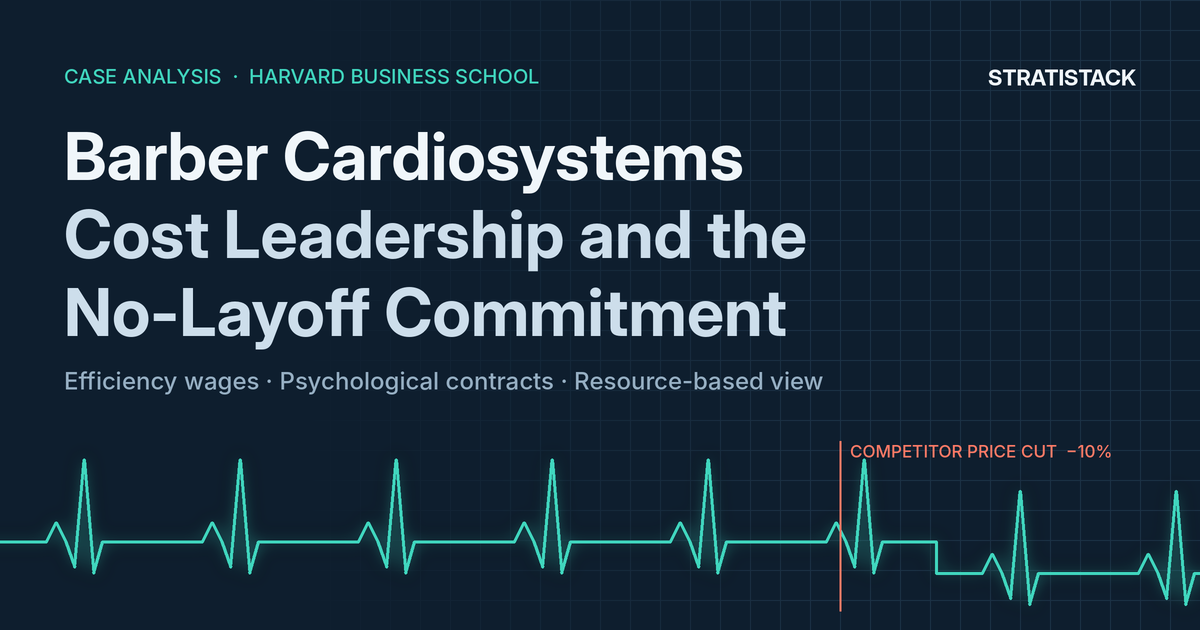
A strategic and human capital analysis of the Harvard Business School case by Ranjay Gulati and Paul S. Myers (2019)
Key takeaways
- Barber Cardiosystems' bonuses and no-layoff guarantee are not perks layered on a cost leadership strategy. They are the mechanism that makes the strategy work.
- Efficiency wage theory explains why paying more can lower unit costs in a high-precision, heavily regulated industry like medical devices.
- Breaking a long-standing job guarantee violates the psychological contract, and the damage to trust and effort is far larger than the money saved.
- The best response to margin pressure is a sequence of voluntary, option-preserving moves (recognition, early retirement, reduced hours, redeployment, contractors), not a blunt cut.
Barber Cardiosystems Case Summary
Barber Cardiosystems is a Melbourne-based medical device manufacturer founded by David Barber in 1978. It makes intra-aortic balloon pumps (IABPs) and ventricular assist devices (VADs), two types of mechanical devices that help the heart pump blood. Ellie Barber-Collins became CEO when her father retired in 2014.
The company competes on cost leadership: high-quality devices sold at a competitive price, built by a loyal workforce supported by a generous bonus system and a guaranteed employment (no-layoff) policy. The central dilemma arrives when a major competitor in the VAD market cuts its prices by 10%, matching or undercutting Barber. Margins and market share come under pressure, and leadership must decide whether the firm can still afford its employment commitments.
This analysis applies Porter's generic strategies, efficiency wage theory, psychological contract theory, the resource-based view, real options thinking and organizational justice theory to answer that question.
The Core Tension: Cost Leadership vs. Employment Commitments
Barber Cardiosystems illustrates a tension that recurs in any industry pursuing a cost leadership strategy in a maturing, price-sensitive market. The practices that generate operational efficiency (generous bonuses, guaranteed employment) are themselves significant fixed costs. And the very success of those practices makes them harder to unwind without damaging the productivity they were designed to protect.
The argument of this analysis is that Barber's commitments are functionally part of its strategy, and that the proposed refinements should be judged as a way of preserving option value rather than as a retreat from those commitments.
1. Porter's Generic Strategies: Cost Leadership as a Structural Choice
Porter's (1985) generic strategies framework treats cost leadership and differentiation as distinct, internally coherent paths to competitive advantage, each requiring its own organizational architecture. A firm cannot simply declare itself a cost leader. It must build every element of its value chain (procurement, manufacturing, labour relations, quality control) around minimizing delivered cost per unit while holding quality at an acceptable threshold.
Barber Cardiosystems has done exactly this, but the case reveals something the textbook version understates. In a regulated, quality-sensitive industry like medical devices, cost leadership cannot be pursued through wage suppression or high turnover, because both would degrade the consistency and defect rates on which regulatory approval and customer trust depend.
That is why Barber's version of cost leadership runs through its workforce rather than around it. It is closer to the operational excellence value discipline described by Treacy and Wiersema (1993), where cost advantage comes from process discipline and employee expertise rather than from scale or input prices alone.
2. Efficiency Wage Theory: Why Generosity Lowers Costs
At first glance, generous bonuses and guaranteed employment seem to contradict cost leadership. Efficiency wage theory (Akerlof and Yellen, 1986; Shapiro and Stiglitz, 1984) explains why they do not.
Paying above-market wages, or offering above-market job security, is a rational cost-minimizing choice when three conditions hold:
- Monitoring worker effort is costly.
- Errors are expensive, as they are for a medical device manufacturer exposed to regulatory recall risk.
- Turnover destroys valuable firm-specific knowledge.
Under these conditions, the firm that pays more actually lowers its total unit cost, because the premium is offset by less shirking, fewer defects and lower retraining expense. Barber's low defect rates and reliable delivery are the observable signature of an efficiency wage equilibrium working as the theory predicts.
This reframes the strategic question. Barber is not choosing between cost leadership and generous employment practices. The generous practices are how it achieves cost leadership in a setting where monitoring and mistakes are costly. Cutting them carelessly risks reversing the very efficiency they produce.
3. Psychological Contract Theory: Why Broken Promises Cost More Than Broken Budgets
Rousseau's (1995) psychological contract theory describes the unwritten set of mutual obligations employees believe exist between themselves and their employer, separate from the formal employment contract.
A no-layoff policy sustained for years does not function in employees' minds as a revocable perk. It becomes a core term of the psychological contract. Research on psychological contract violation (Robinson and Rousseau, 1994) consistently finds that breaching such a term produces effects far larger and longer-lasting than the economic value of the benefit itself, including sharp drops in organizational citizenship behaviour, trust and discretionary effort.
This is the theoretical basis for the case's warning that a sharp reduction in either the bonus system or the no-layoff commitment could undermine the foundation of Barber's strategy. The risk is not linear:
- A 10% cut to a discretionary perk produces roughly proportional dissatisfaction.
- A broken guarantee that employees treated as an implicit promise can produce a disproportionate collapse in trust, because it tells every remaining employee that other implicit commitments may also be revocable.
4. The Resource-Based View: Human Capital as Competitive Advantage
The resource-based view (Barney, 1991) asks whether a firm's resources are valuable, rare and difficult to imitate.
Bonus systems and job guarantees are easy for a competitor to copy on paper. What is hard to imitate is the tacit, accumulated expertise of a workforce that has stayed for years under conditions of genuine trust, which is precisely what Barber has built.
Pfeffer's (1998) work on high-performance work systems argues that bundles of mutually reinforcing HR practices (security, incentive pay, training, information sharing) create advantages that are causally ambiguous and socially complex. Rivals cannot replicate them by copying the policy manual.
This is the strongest argument against a blunt cost-cutting response to the competitor's price cut. Barber's workforce practices are not a cost centre sitting apart from its competitive advantage. They are very plausibly the core of it, and dismantling them to save money in the short run risks destroying the asset that makes the firm's low costs sustainable.
5. Recommendations: Real Options, Not Retreats
Real options theory, developed for capital investment decisions (Dixit and Pindyck, 1994) and increasingly applied to workforce strategy, treats flexibility mechanisms as a way of preserving the option to adjust without triggering a psychological contract violation.
Seen this way, the recommended responses line up along a spectrum, each buying flexibility at a lower cost to trust:
| Recommendation | What it changes | Why it protects trust |
|---|---|---|
| Non-monetary recognition alongside bonuses | Reduces the cash intensity of incentives | Keeps the efficiency wage signal (valued effort, lower monitoring cost) without touching the core guarantee |
| Early retirement incentives and voluntary reduced hours | Adds capacity flexibility | Employees self-select (Milgrom and Roberts, 1992), so no one who values the guarantee has change imposed on them |
| Skill retraining and temporary redeployment | Loosens the fixed cost structure | No one loses their job; the guarantee is honoured in a more flexible form |
| Fixed-term contractors for outsourceable work | Absorbs variable demand | Contractors were never party to the implicit guarantee, so this sits outside the psychological contract entirely |
Why the sequence matters: organizational justice
Organizational justice theory (Adams, 1963; Colquitt, 2001) explains why this order cannot be shuffled for convenience. Employees judge fairness by outcomes, by procedure and by comparison with their own prior treatment.
Opt-in mechanisms that visibly protect long-tenured staff first preserve both distributive and procedural justice. A blanket announcement of bonus or headcount cuts would violate both at once, which is exactly the scenario the psychological contract literature predicts will trigger the productivity collapse Barber is trying to avoid.
6. Strategic Lessons for Managers
- In monitoring-intensive, error-costly industries, generous employment practices can be cost-minimizing. The right question is not whether the firm can afford them, but whether it can afford to lose the efficiency they produce.
- A psychological contract cannot be revised at the pace of a written compensation policy. Changes to long-standing implicit commitments need sequencing, communication and voluntary mechanisms, not unilateral announcements.
- Hard-to-copy human capital practices are often the real source of advantage, even when the formal strategy is labelled cost leadership.
- Flexibility can be bought incrementally. Voluntary programs, contractor buffers and retraining add adaptability without the disproportionate morale losses of a broken guarantee.
- Fairness depends on process, not just outcomes. How a change is introduced, and who bears the first adjustment, matters as much as its size.
Conclusion
Barber Cardiosystems is not facing a simple trade-off between generosity and cost discipline. Its bonus system and no-layoff policy are the operating mechanism of its cost leadership strategy, consistent with efficiency wage theory and the resource-based view of human capital.
The real risk is not that these commitments are too generous to survive a 10% competitor price cut. It is that a poorly sequenced reduction could trigger a psychological contract violation whose costs in trust, effort and defect rates exceed whatever the cuts were meant to save. A voluntary, options-based path is not a retreat from Barber's commitments. It is the way to preserve their value while restoring the adaptability the firm needs to compete.
Frequently Asked Questions
What is the Barber Cardiosystems case about?
It is a Harvard Business School case (Gulati and Myers, 2019) about a Melbourne-based maker of heart-assist devices whose cost leadership strategy depends on a generous bonus system and a no-layoff policy. When a competitor cuts prices by 10%, the CEO must decide whether those employment commitments are still affordable.
What is Barber Cardiosystems' competitive strategy?
Cost leadership achieved through operational excellence: high-quality devices at competitive prices, made possible by low defect rates and a loyal, experienced workforce rather than by low wages.
Should Barber Cardiosystems abandon its no-layoff policy?
No. Breaking the guarantee would likely violate the psychological contract and damage the trust and expertise that keep Barber's costs low. A better path combines non-monetary recognition, voluntary early retirement and reduced hours, retraining and redeployment, and contractors for variable work.
How does efficiency wage theory apply to Barber Cardiosystems?
When effort is hard to monitor, errors are costly and firm-specific knowledge is valuable, paying above market (or guaranteeing employment) lowers total unit cost by reducing shirking, defects and turnover. Barber's medical device setting meets all three conditions.
Which frameworks are useful for analyzing the Barber Cardiosystems case?
Porter's generic strategies, efficiency wage theory, psychological contract theory, the resource-based view, real options theory and organizational justice theory.
References
- Adams, J. S. (1963). Toward an understanding of inequity. Journal of Abnormal and Social Psychology, 67(5), 422–436.
- Akerlof, G. A., & Yellen, J. L. (1986). Efficiency Wage Models of the Labor Market. Cambridge University Press.
- Barney, J. (1991). Firm resources and sustained competitive advantage. Journal of Management, 17(1), 99–120.
- Colquitt, J. A. (2001). On the dimensionality of organizational justice: A construct validation of a measure. Journal of Applied Psychology, 86(3), 386–400.
- Dixit, A. K., & Pindyck, R. S. (1994). Investment Under Uncertainty. Princeton University Press.
- Gulati, R., & Myers, P. S. (2019). Barber Cardiosystems. Harvard Business School case.
- Milgrom, P., & Roberts, J. (1992). Economics, Organization and Management. Prentice Hall.
- Pfeffer, J. (1998). The Human Equation: Building Profits by Putting People First. Harvard Business School Press.
- Porter, M. E. (1985). Competitive Advantage: Creating and Sustaining Superior Performance. Free Press.
- Robinson, S. L., & Rousseau, D. M. (1994). Violating the psychological contract: Not the exception but the norm. Journal of Organizational Behavior, 15(3), 245–259.
- Rousseau, D. M. (1995). Psychological Contracts in Organizations: Understanding Written and Unwritten Agreements. Sage.
- Shapiro, C., & Stiglitz, J. E. (1984). Equilibrium unemployment as a worker discipline device. American Economic Review, 74(3), 433–444.
- Treacy, M., & Wiersema, F. (1993). Customer intimacy and other value disciplines. Harvard Business Review, 71(1), 84–93.