If the AI Boom Busts, Who Pays for the Grid? A Stress Test of Data Center Tariffs
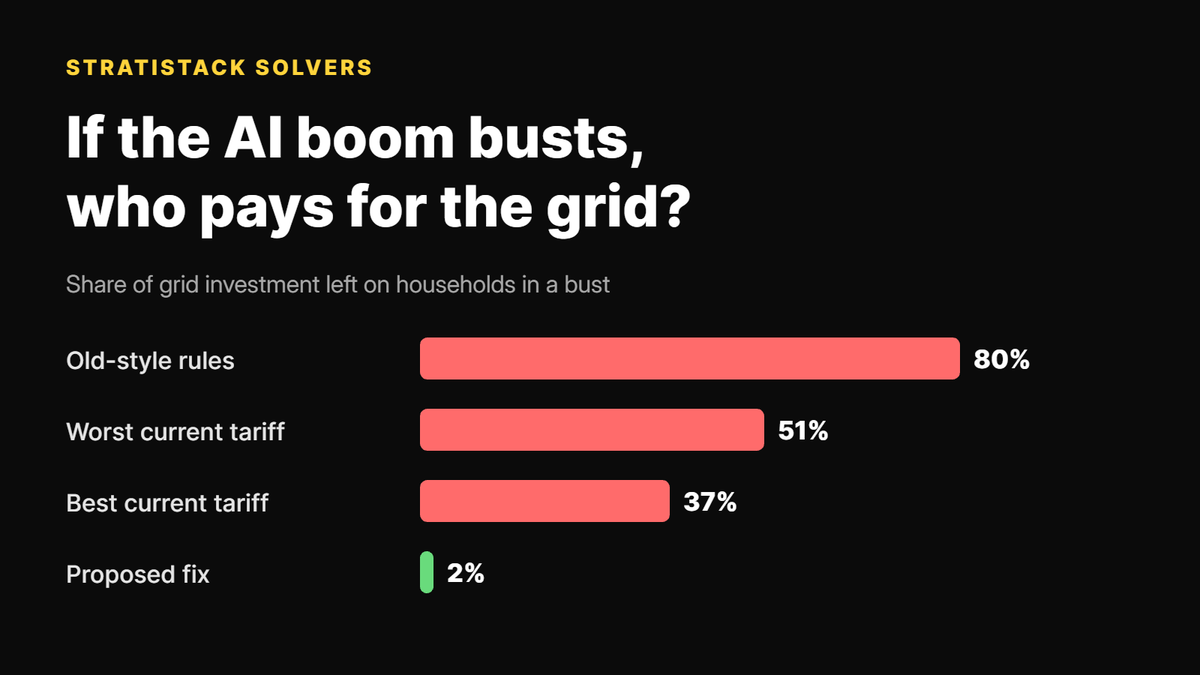
States now make data centers sign long contracts and pay minimum bills. We stress-tested four real tariffs against an AI bust: households still carry 37% to 51% of the grid investment. Here is why, and a model tariff that closes the gap.

Stratistack Solvers #2 · We don't just analyse problems, we propose fixes · Original analysis is labelled as analysis
Abstract
Utilities are building billions of dollars of grid equipment for data centres, and states have responded with "large-load tariffs" meant to stop those costs landing on households. This brief asks a narrow question: if the AI boom turns to bust and data centres leave, how much of that grid investment do current tariffs actually protect? We built a stress test that runs four real tariffs (Ohio, Virginia, Kansas/Missouri and Michigan) and an old-style baseline through the same simulated departures, defaults and bankruptcies. The modern tariffs are a large improvement on old rules, but in a bust they still leave an expected 37% to 51% of the grid investment on other customers' bills. The cause is structural. Contracts run 12 to 15 years, the equipment lasts 40 years or more, and exit fees recover the remaining contract payments, not the remaining value of the equipment. We propose a fix, a departure charge tied to the equipment's undepreciated book value and backed by collateral for weaker borrowers, which cuts household exposure to roughly 0% to 2% in every scenario we tested. A model tariff is included.
Key findings
- The new rules help. Under old-style terms, an AI bust leaves an expected 75% to 80% of the grid investment on households in our model. The four modern tariffs cut that to 37% to 51%.
- They don't close the gap. When a 12-year contract ends, 73% of a 45-year grid asset is still on the books. At 14 and 15 years, 69% and 67% remain. A witness in Virginia's rate case estimated 61% at 14 years (Piedmont Environmental Council, 2025).
- The exit fee measures the wrong thing. Most tariffs charge a departing customer its remaining minimum bills. That recovers the contract, not the asset. Under Virginia's tariff in our bust scenario, nearly all of the leftover cost for investment-grade customers comes from customers who paid everything their contract required and still left a balance behind.
- Stratistack analysis: a fix exists. A departure charge equal to the undepreciated book value, plus collateral for customers below investment grade, cuts household exposure to about 0% to 2% across all three scenarios.
- It has a precedent. NV Energy already sets its exit fee at the remaining cost of the contracted asset (Frick et al., 2026).
Why this matters now
A study published today in Nature Energy by Cornell researchers found that in 2025, across four major US grids, data centres paid $3.12 billion of the $8.25 billion in energy infrastructure costs linked to their growth. The remaining $5.13 billion, 62%, fell largely on residents, with the heaviest burden on rural and low-income households (Cornell Chronicle, 2026). Harvard's Electricity Law Initiative reviewed nearly 50 regulatory proceedings and described how utility rate structures and confidential contracts can move data centres' energy costs onto the public (Martin & Peskoe, 2025).
States have responded with large-load tariffs. A 2026 review by Lawrence Berkeley National Laboratory and the Brattle Group analysed 55 of them and found the median minimum contract term rose from 5 years before 2025 to 12 years since, with a median minimum bill of 80% of contracted demand (Frick et al., 2026). The review describes stranded-cost risk but does not put a number on it. That is the gap this brief fills.
The risk is not hypothetical. When AEP Ohio required real financial commitments, a data-centre pipeline it had described as more than 30 GW shrank to 13 GW of formal study requests and then to 5,642 MW of signed contracts (New Project Media, 2026). Speculative demand is real, and some AI companies fail: Character.AI went bankrupt in 2026 despite 12 million users, as we covered in our unit-economics breakdown.
What you can do: look up whether your utility has a large-load tariff. The Database of Emerging Large-Load Tariffs (DELTa) and the Edison Electric Institute both track them.
The tariffs we tested
| Tariff | Contract | Minimum bill | Exit fee | Collateral |
|---|---|---|---|---|
| AEP Ohio, Schedule DCT | Ramp (up to 4 yrs) + 8 yrs | 85% | 36 months of minimum charges, only after year 5 following ramp | 50% of minimum charges over the term, stepping down |
| Dominion, GS-5 (Virginia, from 2027) | 14 yrs | 85% (T&D), 60% (generation) | Remaining minimum charges; 3 years' notice to reduce | Up to 60% of minimum charges over the term if credit is insufficient |
| Evergy, LLPS (Kansas/Missouri) | 15 yrs (as proposed) | 80% | Minimum bill × greater of remaining term or 1 year; 36 months' notice | Not specified in sources read |
| Consumers Energy (Michigan) | 15 yrs, up to 5-yr ramp | 80% | Remaining minimum bills; 4 years' notice | Not specified in sources read |
| Legacy baseline (stylised) | 5 yrs | None | None | None |
Sources: AEP Ohio (n.d.); Frick et al. (2026); Brattle Group (2025); Government Technology (2026); Virginia SCC testimony reported by SOAR (2026); Thomas Jefferson Institute (2025). The legacy baseline uses the pre-2025 median term from Frick et al. and is otherwise stylised.
The framework: a term mismatch, not a pricing mistake
Utilities recover grid investments slowly. A substation or transmission line goes into the rate base and is paid off through depreciation plus a return over its service life. Florida's regulator lists industry average service lives of about 44 years for station equipment and 50 years for transmission towers (Florida PSC, 2008), and a Texas depreciation filing reported tower lives across Texas utilities ranging from 45 to 81 years, averaging 61 (Public Utility Commission of Texas, n.d.). Data-centre contracts, by contrast, run 12 to 15 years.
Corporate finance has a name for this: an asset-liability mismatch. A bank that funds 30-year mortgages with overnight deposits is exposed when depositors leave. A utility that funds 45-year grid assets with 14-year customer contracts is exposed the same way when customers leave. The difference is who absorbs the loss. For a bank, it is shareholders and depositors. For a regulated utility, unrecovered costs are usually spread across the remaining customers.
Exit fees in most tariffs are designed around the contract, not the asset. "Remaining minimum charges" means the customer pays what it would have paid had it stayed until the contract ended. In a cost-based rate, that covers depreciation and return for those years only. Everything scheduled for after the contract ends stays on the books.
Methods note
We measured exposure per unit of grid investment, so results are percentages of what was spent. All code is Python (NumPy). This is Stratistack analysis, not observed data.
- Cost recovery. Straight-line depreciation over 45 years, with an annual revenue requirement of depreciation plus a 6.5% return on the remaining balance. That return is consistent with recent overall authorised returns of about 6.4% to 6.6% in Indiana cases tracked by S&P Global (2025).
- Defaults. Annual default probabilities were derived from S&P static-pool 15-year cumulative default rates: 2.15% for investment grade and 23.13% for speculative grade (PM Research, 2000). These are older long-run averages. If a customer defaults, collateral is recovered in full and any remaining exit-fee claim is recovered at 37.6%, Moody's long-term average for senior unsecured bonds (Moody's, 2024).
- Scenarios (assumptions). Three scenarios set how often solvent customers leave and how often departing capacity is taken up by a new customer:These are not forecasts. They are stress levels chosen to show how each tariff behaves.
- Steady growth: 0.5% leave per year during the contract, 10% leave at its end, 70% of departing capacity is re-used.
- AI correction: 3% per year early on, 30% at contract end, 40% re-used.
- AI bust: 8% per year in the first five years, 60% at contract end, 10% re-used, with default rates four times normal in the first five years.
- Simplifications. We modelled the grid investment only, assumed demand charges are cost-based, ignored ramp-period shortfalls, and applied collateral only to customers below investment grade, since tariffs typically relax it for strong credit (Frick et al., 2026). Each case ran 200,000 times.
Results: every current tariff leaks in a downturn
| Expected share left on other customers | Steady | Correction | Bust |
|---|---|---|---|
| Legacy baseline | 11% / 16% | 38% / 44% | 75% / 80% |
| AEP Ohio DCT | 8% / 13% | 28% / 32% | 51% / 51% |
| Dominion GS-5 | 6% / 8% | 22% / 22% | 41% / 37% |
| Evergy LLPS | 6% / 11% | 22% / 29% | 41% / 49% |
| Consumers Energy | 6% / 11% | 21% / 28% | 39% / 48% |
| Stratistack model tariff | 0.5% / 0% | 1% / 0% | 2% / 0% |
Each cell shows investment-grade customer / below-investment-grade customer.
Three patterns stand out. First, the modern tariffs roughly halve exposure compared with old rules in a bust, and cut it by more in good times. Second, longer terms and higher minimums help but do not change the shape: the remaining exposure is concentrated in departures, at contract end or after it, and in exits during the term where the fee covers only the contract. Under Virginia's tariff in the bust scenario, exposure for an investment-grade customer splits almost evenly: about 20 points from exits during the term and 21 points from departures after it. Third, Virginia's collateral rule matters. It is the only one of the four where weaker borrowers come out slightly better than strong ones, because their collateral backstops part of the gap.
What you can do: if you follow your state's proceedings, ask one question: what share of the grid investment will still be on the books when the contract ends, and who pays it if the customer leaves?
The fix: charge for the asset, not the contract
The design search tested 162 combinations of contract length, minimum bill, exit-fee rule, collateral and upfront payment. We looked for the cheapest package, for the data centre, that kept expected household exposure at or below 2% in the bust scenario for both strong and weak borrowers. The winner was not a longer contract or a higher minimum bill. It was a different exit rule.
Under a book-value departure charge, a customer that leaves at any point in the asset's life pays the undepreciated value of the grid investment made for it, less anything recovered by assigning its capacity to a new customer. On its own, that protects households against investment-grade customers, whose only remaining risk is a rare default (about 2% exposure in the bust). For weaker borrowers, a departure charge is only as good as their ability to pay, so it needs collateral. Without collateral, expected exposure for below-investment-grade customers stays at 17% in a bust. With collateral equal to the outstanding balance, it falls to zero. A middle option, 50% collateral plus 25% paid upfront, gets it to about 4%.
This keeps the contract term short, which data centres want, while making the tail of the asset someone's explicit obligation. It mirrors NV Energy's approach, where the exit fee equals the remaining cost of the contracted asset (Frick et al., 2026). It also fits Pennsylvania's model-tariff guidance that large customers should pay for interconnection costs, including network upgrades that would not otherwise be built (Frick et al., 2026).
The Stratistack Model Large-Load Tariff (one page)
- Scope. Applies to the grid investment the utility makes to serve the customer: interconnection, network upgrades and any capacity built or reserved for it.
- Book-value departure charge. If the customer reduces or ends service at any time before the investment is fully depreciated, it pays the undepreciated book value attributable to the released capacity.
- Reassignment credit. The charge is reduced by any capacity the utility reassigns to a new customer within 24 months.
- Collateral for weaker credit. Customers below investment grade post a letter of credit or cash equal to the outstanding departure charge. It steps down each year as the asset depreciates and is released when the customer reaches investment grade.
- Contract and minimum bill. Keep a 12-year term and an 80% minimum bill priced at cost of service. The departure charge, not the term, protects the tail.
- Transparency. The utility reports each year the total undepreciated large-load investment, the collateral held and the share each customer class would bear if every large customer left.
Calculator: what's left when a data centre leaves?
Stratistack model. Straight-line depreciation; revenue requirement = depreciation + 6.5% return on the remaining balance; minimum charges discounted at 6.5%. Assumes the customer pays what it owes and nobody takes over the capacity. Defaults and re-use are in the full model, not here.Counter-evidence and limitations
- Re-use may be high. In a growing grid, capacity a data centre releases is often valuable to the next customer. Our steady-growth scenario assumes 70% re-use. If re-use is higher, current tariffs look better. In Virginia's tariff under the bust scenario, exposure for weaker borrowers falls from 41% to 16% as re-use rises from 0% to 60%.
- Data centres may be net positive for ratepayers. Two E3 studies, one examining Amazon data centres and one funded by data-centre developer CloudHQ, found that data centres under modern tariffs can cover their cost of service or lower rates for others. They also show that tariff design, not data centres themselves, determines the outcome.
- Asset life matters. With a 35-year life, Virginia's bust exposure for weaker borrowers falls to 32%. With 60 years it rises to 41%. The direction of the finding holds either way.
- The scenarios are assumptions. No public dataset gives exit rates for data centres under these new contracts, which are only a year or two old. Our default rates come from long-run corporate averages, not data-centre specific data.
- Not every term is modelled. We did not model generation costs, ramp-period shortfalls, the 60% generation minimum in Virginia, or collateral terms we could not verify for Evergy and Consumers Energy. Treating those two as having no collateral may overstate their exposure for weaker borrowers.
- Collateral has a cost. A departure charge backed by full collateral ties up capital, and some developers will choose other states. That is a policy trade-off, not a modelling result.
What the evidence supports
The evidence supports a specific change. Today's large-load tariffs are built to stop speculative projects and recover the contract, and they do both reasonably well. They are not built to recover the asset. Because grid equipment outlives data-centre contracts by decades, a downturn would leave a large share of the investment on other customers even when every data centre pays everything it owes. A departure charge tied to undepreciated book value fixes the mismatch directly, keeps contracts short and flexible, and puts the cost on the party that caused it. Regulators can add it to existing tariffs without redesigning them.
What would change this view
- Evidence that capacity released by data centres is reliably re-used by new load within a few years, even in a downturn.
- Utility filings showing that grid investments for large loads are depreciated over periods close to the contract term.
- Tariff provisions we could not verify, such as collateral or post-term charges, that already cover the tail of the asset.
- Observed exit data from the first cohort of modern large-load contracts showing much lower departure rates than our correction and bust scenarios.
FAQ
Do data centres raise household electricity bills?
They can. A 2026 Nature Energy study by Cornell researchers found data centres paid 38% of related infrastructure costs on four major US grids in 2025, with households bearing much of the rest. Outcomes depend heavily on tariff design.
What is a large-load tariff?
A special rate for very large customers such as data centres, usually with long contracts, minimum bills, exit fees and collateral, designed to stop costs shifting to other customers.
Why don't current exit fees fully protect households?
Most charge the remaining minimum bills on the contract. Grid equipment lasts 40 years or more, so when a 12 to 15-year contract ends, about two-thirds of its value is still unpaid in our model.
What is a book-value departure charge?
An exit fee equal to the undepreciated value of the grid investment made for the customer, owed whenever the customer leaves before the asset is paid off. NV Energy uses a similar approach.
How much protection does the proposed tariff give?
In our stress test, with collateral for weaker borrowers, expected household exposure fell to about 0% to 2% of the grid investment across all scenarios, compared with 37% to 51% under current tariffs in a bust.
Related on Stratistack
- Character.AI had 12 million users and still went bankrupt
- When AI negotiates for you, the weaker agent pays
- Five tech failures, one pattern
References
[PR] = peer-reviewed.
AEP Ohio. (n.d.). Data center tariff. https://www.aepohio.com/company/about/rates/data-center-tariff
Brattle Group. (2025). Large loads interconnection tariff designs and state actions. https://www.brattle.com/wp-content/uploads/2025/09/Large-Loads-Interconnection-Tariff-Designs-and-State-Actions.pdf
Cornell Chronicle. (2026, November 9). Data centers need power – lower income, rural residents pay the price [Reporting on Feng & You, Nature Energy]. https://news.cornell.edu/stories/2026/11/data-centers-need-power-lower-income-rural-residents-pay-price
E3. (2026, June). Beyond the headlines: Large load economics [Funded by CloudHQ]. https://www.ethree.com/wp-content/uploads/2026/06/E3_Large-Load-Economics_June-2026.pdf
Florida Public Service Commission. (2008). Order No. PSC-08-0094-PAA-EI. https://floridapsc.com/library/Orders/2008/08-0094.ord.doc
Frick, N. M., Cappers, P., Kavlak, G., Lam, L., Hledik, R., Grove, J., & Rotella, S. (2026). Electricity rate designs for large loads: Evolving practices and opportunities, 2026 update. Lawrence Berkeley National Laboratory. https://eta-publications.lbl.gov/sites/default/files/2026-08/rate_designs_large_loads_2026.08.10.pdf
Government Technology. (2026). Ohio, neighboring states safeguard electric customers. https://www.govtech.com/artificial-intelligence/ohio-neighboring-states-safeguard-electric-customers
Martin, E., & Peskoe, A. (2025). Extracting profits from the public: How utility ratepayers are paying for Big Tech's power. Harvard Electricity Law Initiative. https://eelp.law.harvard.edu/wp-content/uploads/2025/03/Harvard-ELI-Extracting-Profits-from-the-Public.pdf
Moody's Investors Service. (2024, February 26). Annual default study: Corporate default rate to moderate in 2024 but remain near its long-term average.
New Project Media. (2026). AEP Ohio touts 'right-sized load' as data center pipeline shrinks further under new tariff. https://newprojectmedia.com/policy-aep-ohio-touts-right-sized-load-as-data-center-pipeline-shrinks-further-under-new-tariff/
Piedmont Environmental Council. (2025, November 25). PEC reacts to SCC decisions in the biennial rate case. https://www.pecva.org/resources/press/press-release-piedmont-environmental-council-reacts-to-scc-decisions-in-the-biennial-rate-case/
PM Research. (2000). Credit ratings and recovery experience: An overview [S&P static-pool cumulative default rates, Exhibit 1]. https://pm-research.com/content/iijretire/2000/1/45.full.pdf
Public Utility Commission of Texas. (n.d.). Direct testimony on depreciation, WETT transmission assets (Docket 40606). https://interchange.puc.texas.gov/Documents/40606_2_735339.PDF
S&P Global Market Intelligence. (2025, July). Pending utility rate cases signal an active July for regulators. https://www.spglobal.com/market-intelligence/en/news-insights/research/2025/07/pending-utility-rate-cases-signal-an-active-july-for-regulators
SOAR Citizen Portal. (2026, February 3). State Corporation Commission orders new GS-5 rate class for large data-center customers. https://cpo.soar.com/articles/7371359/
Thomas Jefferson Institute. (2025). The SCC decides: Dominion's rates and profits go up, new rules on data centers. https://www.thomasjeffersoninst.org/the-scc-decides-dominions-rates-and-profits-go-up-new-rules-on-data-centers/
If this was useful, subscribe. Stratistack Solvers proposes fixes for problems most coverage only describes. One evidence-checked brief a week, free in your inbox.